
See what is already claimed
Filings by debtor with secured party, collateral scope, dates, amendments, and active or lapsed status.
Pull existing liens, corroborate that the business is real and operating, and check public reputation — assembled into a single reviewable profile instead of four browser tabs.
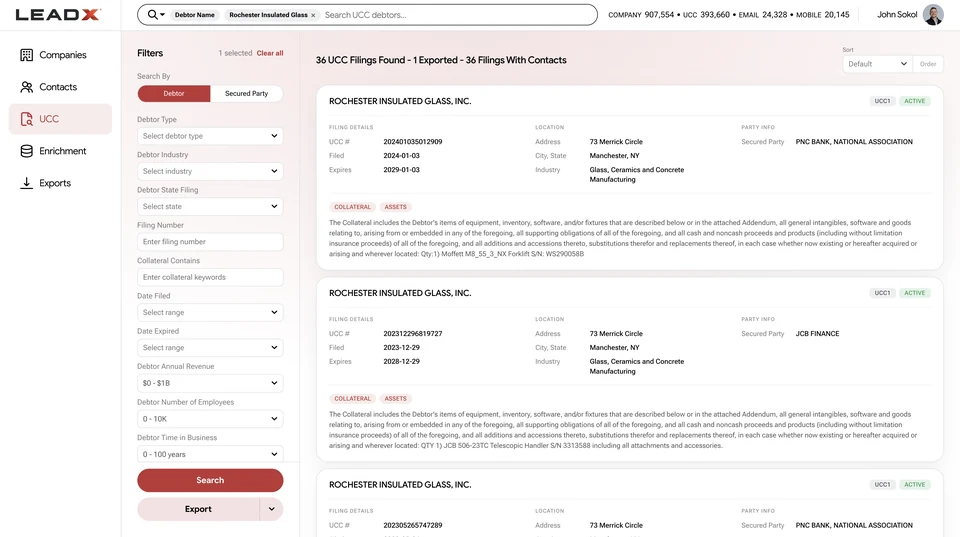
Registrations sit with one state, filings with another, reviews and complaints somewhere else again, and none of them agree on how the company is named. LeadX resolves those sources to one company entity so an analyst can see secured claims, operating evidence, and reputation together, and document the check without reconciling four systems by hand. Learn how to screen a business for credit risk. See how this works for business lending teams.
Filings by debtor with secured party, collateral scope, dates, amendments, and active or lapsed status.
Registrations, firmographics, website, and location data confirm the entity is real and active.
Google review volume and ratings, plus BBB accreditation and complaint context.
Export the assembled profile or pull it through the API into a case-management workflow.
Assemble filings, registrations, and reputation before capital is committed.
Understand what is pledged, to whom, and whether the filing is live.
Corroborate that an applicant matches a real, operating business.
Keep a consistent, reviewable record of what was checked.
State business registrations to confirm the entity exists, UCC filings to establish existing secured claims, reputation signals such as Google reviews and BBB records, and firmographics and web presence to corroborate that the business is operating.
Run a debtor search. Results list each filing with its secured party, collateral description, filing and lapse dates, amendment history, and current status, so active claims can be separated from historical ones.
No. LeadX is not a consumer reporting agency and does not issue credit scores or bureau tradeline files. It supplies public-record, firmographic, and reputation data used to research and prioritise, alongside — not instead of — the regulated sources your credit policy requires.
No. Filing a financing statement is standard practice in equipment leasing and asset-backed lending, and its presence mainly tells you the business finances assets. Scope, recency, secured party, and whether earlier filings remain active are what carry meaning.
Yes. Company, filing, review, and BBB data are available through the REST API and bulk delivery, which is how teams feed internal scoring models and case-management systems.
Whether a filing is a blanket lien over substantially all assets or limited to named equipment. That affects where a new facility would sit relative to existing claims. See the glossary.