
Find companies with relevant filings
Search and filter debtor records by name, type, industry, location, filing state, and company characteristics.
Search more than 50 million UCC-1 and UCC-3 filings by debtor, secured party, and collateral. Inspect status and amendment history, connect every filing to a full company record, and export qualified results with decision-maker contacts included.
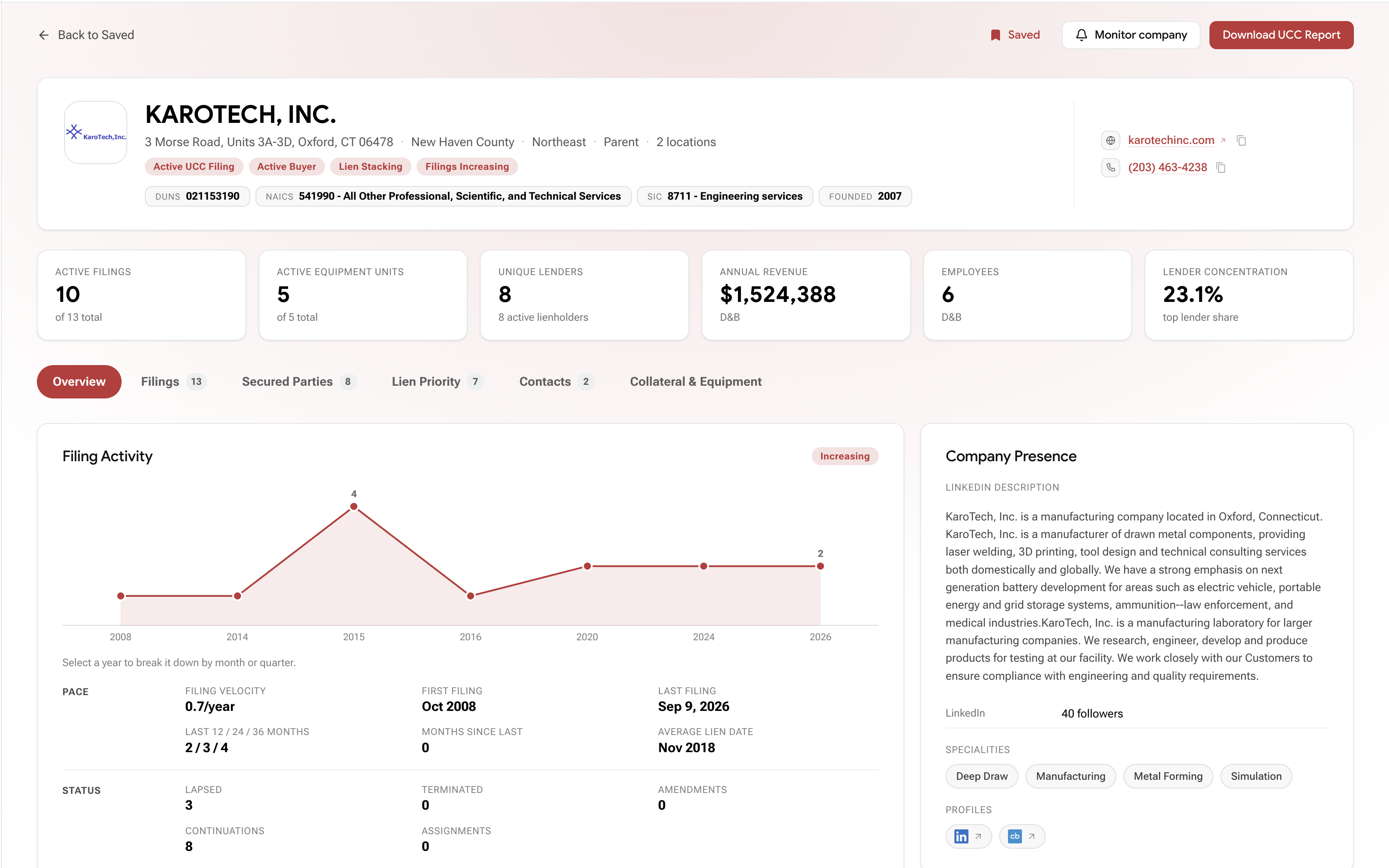
LeadX organizes UCC records around debtor and secured-party search, filing lifecycle, collateral language, industry, geography, and connected company identity. The result is a workflow built for finding opportunities, researching relationships, monitoring portfolios, and exporting usable account lists. Learn how to monitor UCC filing changes and analyze UCC results at scale.
Search and filter debtor records by name, type, industry, location, filing state, and company characteristics.
Search secured parties, review connected debtors, and understand patterns across filings and markets.
Search collateral text and use classified asset signals to identify equipment, inventory, and other relevant interests.
Review filing dates, lapse or expiration timing, UCC type, amendment history, and current status.
Add firmographics, web data, reputation signals, industry, contact channels, and related business intelligence.
Export selected records and contacts or integrate debtor and secured-party search through LeadX APIs.
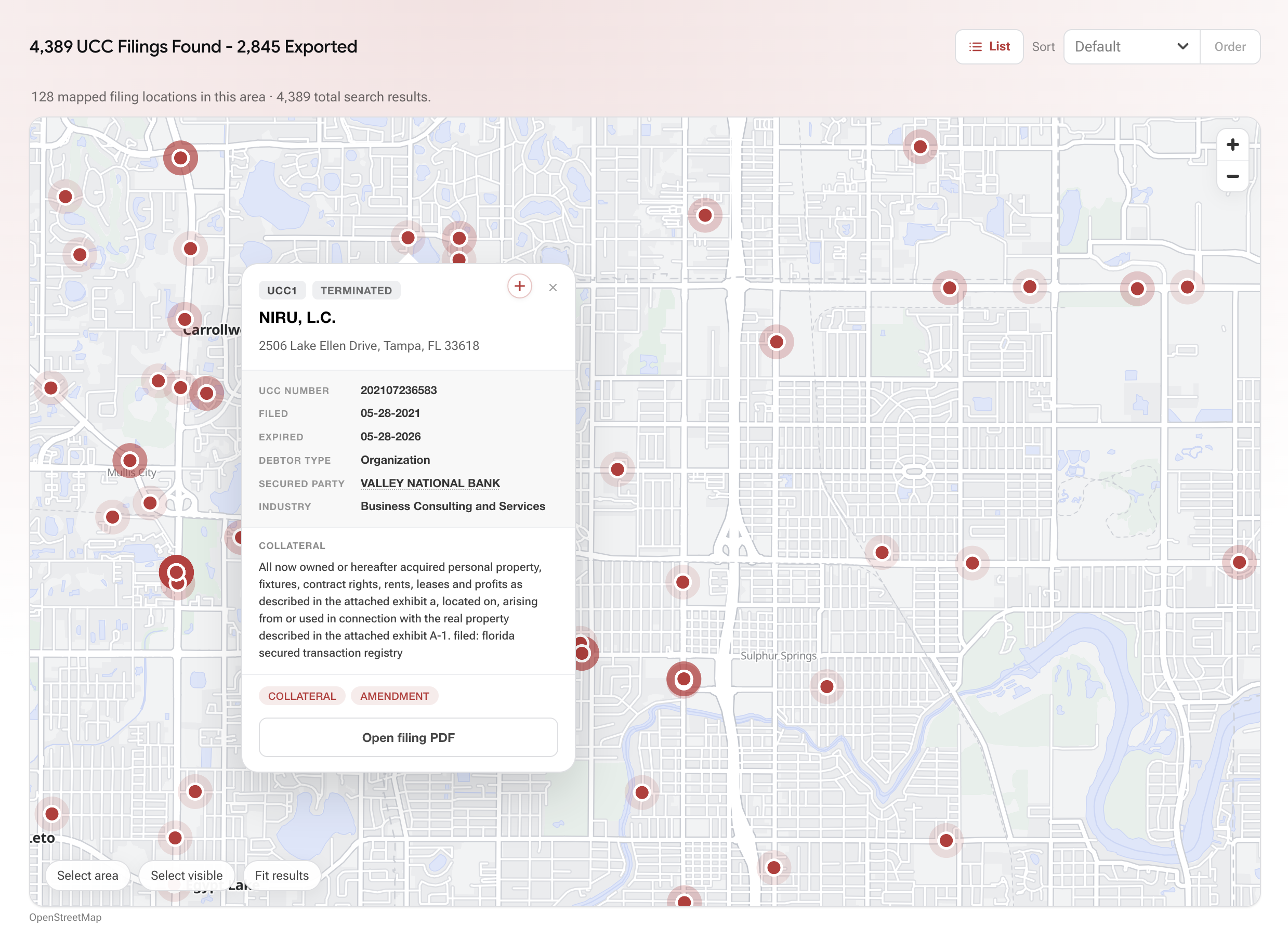
View mapped filing locations, focus on an area, and inspect a selected filing’s status, secured party, dates, and collateral.
Identify companies with financing and collateral signals relevant to your market.
Understand debtor, secured-party, and filing connections before outreach or underwriting.
Track filing activity and changing business signals across known accounts. Scheduled UCC monitoring reports deliver new filings against a saved debtor list on a weekly or monthly basis.
Bring UCC records into internal scoring, research, and account-management systems.
UCC filing data is the public record created when a lender, lessor, or other creditor files a financing statement under Article 9 of the Uniform Commercial Code to perfect a security interest in a business borrower’s collateral. Filings are submitted to a state filing office — usually the Secretary of State in the debtor’s state of formation — and become searchable public record.
Each record identifies the debtor, the secured party, and the collateral pledged, along with filing dates, the filing type, and any amendments. Because a filing marks the moment a business financed equipment, inventory, receivables, or real assets, UCC filing data is widely used as a buying and credit signal for prospecting, competitive research, portfolio monitoring, and underwriting.
The initial filing that perfects a secured party’s interest in a debtor’s collateral. A UCC-1 is generally effective for five years unless it is continued.
Continuations, amendments, assignments, and terminations that change or extend an existing filing, forming the lifecycle of the original record.
The company that pledged the collateral. Debtor names and addresses are how UCC filing data is connected back to real company records.
The lender, lessor, bank, or finance company holding the security interest — the basis for competitive and relationship research.
The free-text description of pledged assets: equipment, vehicles, inventory, receivables, or all-asset language that signals the type of financing.
Filing dates, lapse timing, and current status separate live financing relationships from historical ones.
UCC filing data is the public record produced when a creditor files a financing statement under Article 9 of the Uniform Commercial Code to perfect a security interest in a business borrower’s collateral. Each record names the debtor, the secured party, and the collateral pledged, along with filing dates, filing type, and amendment history.
Yes. UCC financing statements are filed with state filing offices — typically the Secretary of State in the debtor’s state of formation — and are public record. LeadX aggregates these filings, standardizes them, and connects them to company records so they can be searched and analyzed at scale.
A UCC-1 is the initial financing statement that perfects a secured party’s interest in collateral. A UCC-3 is a subsequent filing that amends the original record — a continuation that extends it, an amendment that changes debtor, secured party, or collateral details, an assignment that transfers the interest, or a termination that releases it.
A UCC-1 financing statement is generally effective for five years from the filing date. The secured party can extend it by filing a UCC-3 continuation, normally within the six months before it expires. If no continuation is filed, the record lapses. Certain filings, such as public-finance and manufactured-home transactions, run longer.
The LeadX database holds more than 50 million UCC filings, aggregated from state filing offices and connected to company records. Coverage spans UCC-1 financing statements and the UCC-3 continuations, amendments, assignments, and terminations that change them, so a filing can be traced across its full lifecycle rather than viewed as a single snapshot.
It depends on the state, because filing offices publish on very different schedules. LeadX collects from each jurisdiction at whatever cadence that state releases. As LeadX founder and CEO John Sokol described it to Equipment Finance News: “For example, in California we procure that data set weekly. Oregon is monthly. Florida is daily.” Records are ingested as soon as a state makes them available rather than on a fixed national schedule.
Yes, and this is where a lot of the engineering goes. Collateral descriptions on filings scanned from the 1990s and 2000s carry misspellings and transcription errors that break naive keyword search. LeadX parses that text to detect inaccuracies, and where they exceed a threshold, runs it through a large language model to correct them — which is what makes searching decades of filings by manufacturer or equipment type dependable.
LeadX supports search from both directions. Debtor search finds the filings tied to a company you are researching. Secured-party search finds every debtor associated with a given lender or lessor, which is how teams map a competitor’s book of business or an existing portfolio. Both can be combined with collateral keywords, filing dates, filing status, and company filters.
Yes, among other things. Alongside search and export, LeadX runs scheduled UCC monitoring: saved search criteria are re-run on a weekly or monthly schedule and any new filings matching them are delivered as a report. Teams use that to watch a lending portfolio, a territory, or a competitor’s secured-party activity without re-running searches by hand.
UCC debtor tracking follows a named set of businesses over time rather than running a one-off search. You define the debtors — an existing book, a target account list, or a filter such as an industry and filing state — and LeadX reports the new filings, continuations, amendments, and terminations recorded against them, with company and contact context attached to each result.
Yes, and it is one of the most common uses. A filing is evidence that a business financed an asset, which makes it a timing signal for equipment finance, business lending, and B2B sales teams. Because LeadX joins filings to firmographics and decision-maker contacts, a filing search can be turned directly into a contactable prospect list rather than a list of names to research.
Collateral text describes the assets pledged in the transaction — specific equipment, vehicles, inventory, and receivables, or broad all-asset language. Searching and classifying that text identifies what a company financed, which indicates the type of lender involved and whether the business fits your target profile.
Yes. UCC search is available through the LeadX API alongside company, contact, review, and enrichment endpoints, and through enterprise bulk delivery for teams that load filings into their own systems. See the API & bulk data page or the API documentation.