
See secured claims and their status
Filings by debtor with secured party, collateral scope, dates, amendments, and active or lapsed status.
Check whether a business is real and operating, what secured claims already exist against it, and what its public reputation looks like — assembled into a single reviewable record.
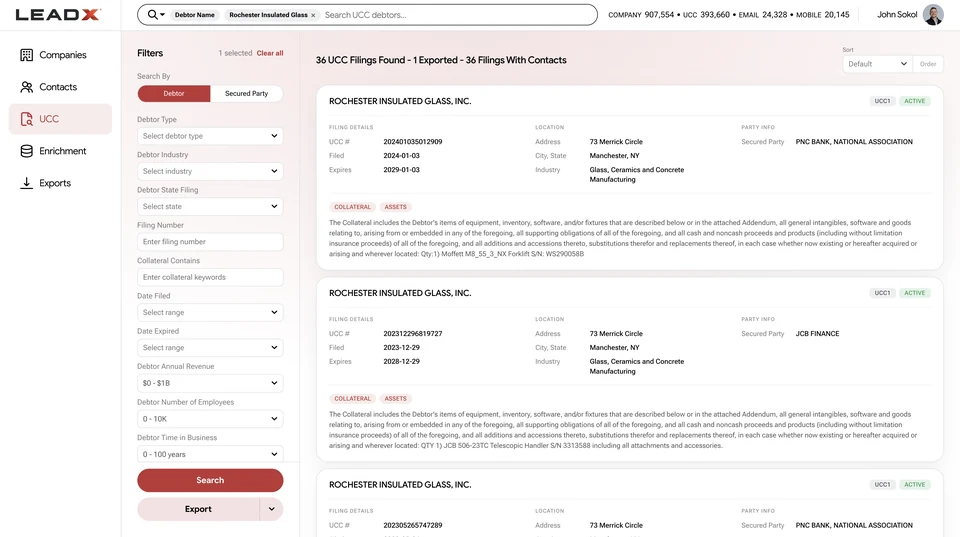
Registrations, filings, reviews, and web presence each tell part of the story and usually live in separate systems. LeadX resolves them to one company entity so an analyst can see existing liens, corroborate that the business is operating, and document the check without moving between four tools.
Filings by debtor with secured party, collateral scope, dates, amendments, and active or lapsed status.
Registrations, firmographics, website, and location data confirm a business is real and active.
Google review counts and ratings, plus BBB accreditation and complaint context.
Export the assembled profile or pull it through the API into an internal risk workflow.
Assemble filings, registrations, and reputation before capital is committed.
Inspect what is already pledged and to whom, and whether the filing is live.
Watch existing accounts for new filings, amendments, and terminations.
Corroborate that an applicant matches a real, operating business.
Commonly four inputs: state registrations to confirm the entity exists, UCC filings to establish existing secured claims, reputation signals such as Google reviews and BBB records, and firmographics and web presence to corroborate that the business is operating. LeadX resolves these to one company record.
Run a debtor search on UCC filing data. The result lists each filing with its secured party, collateral description, filing and lapse dates, amendment history, and whether it is active, lapsed, or terminated.
No. A filing simply records that a creditor perfected a security interest, which is routine for equipment leases and asset-backed lending. What matters for risk work is the pattern: how many filings, against what collateral, held by whom, and whether they are still active.
No. LeadX provides public-record, firmographic, and reputation data used to research and prioritise. It does not provide consumer credit reports or scores, and it is not a consumer reporting agency. Underwriting decisions should rest on your own policy and the appropriate regulated sources.
Yes. Company, filing, review, and BBB data are available through the REST API and enterprise bulk delivery for teams running internal scoring or case-management workflows.
UCC filings from state filing offices, Secretary of State business registrations, Better Business Bureau records, and Google review data, combined with firmographics and website intelligence. Each is attached to the same resolved company record so an analyst reviews one profile rather than four sources.