
Define the slice
Filter by industry, geography, size, filing activity, or equipment before delivery rather than after.
Load targeted company, contact, UCC filing, and equipment ownership data into your warehouse, scoring model, or product — as scheduled files or through the API.
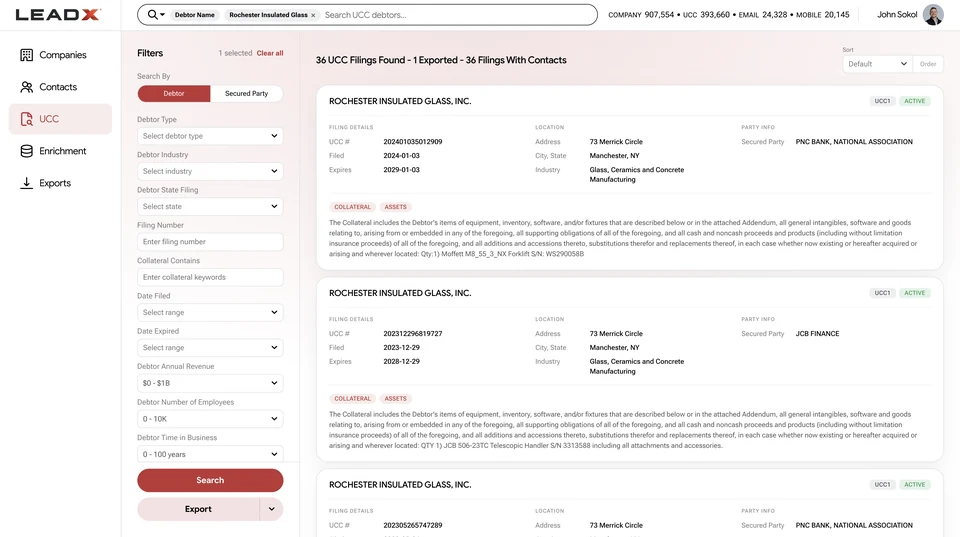
Backfilling a warehouse, training a model, or powering a product feature does not fit a synchronous API call. Bulk delivery hands over a defined slice of the dataset on a schedule you set, already resolved to one company entity, so the receiving system is not left doing vendor deduplication before it can do anything useful. Learn how to run a bulk enrichment workflow and analyze UCC results at scale.
Filter by industry, geography, size, filing activity, or equipment before delivery rather than after.
File delivery for warehouse loads, or the REST API for systems that prefer to pull.
One-off extracts for a backfill, or recurring delivery for a dataset that has to stay fresh.
Records resolve to a single company entity upstream, so joins do not become a cleanup project.
Load a historical slice for analytics and model training.
Feed internal risk or propensity models with consistent inputs.
Power a lookup or insight feature inside your own SaaS product.
Replace or append on a schedule so downstream systems stay current.
Taking delivery of a defined slice of a dataset as files, rather than querying record by record. It is the normal path for warehouse loads, model training, and product features that need the data resident in your own systems. See API and bulk data.
Use the API for synchronous lookups where you need one record now. Use bulk when the workload is volume: backfilling history, refreshing a warehouse table, or feeding a model. Many teams use both.
Company records, contacts, UCC filings, equipment ownership, Google review and BBB signals — scoped to the segment you define rather than delivered wholesale.
Yes. Bulk delivery supports one-off extracts and recurring schedules, so a dataset that has to stay current can be replaced or appended without a manual request each time.
Yes. Records resolve to a single company entity upstream, so the same business does not arrive as several rows under name and address variants.
Yes. Alongside bulk files and the REST API, LeadX publishes an authenticated MCP server so assistants can query under your account’s own permissions, rate limits, and credit charges.