
Query records synchronously
Company, contact, email, mobile, UCC, BBB, and review endpoints with documented pagination and rate limits.
Bring company, contact, UCC filing, equipment ownership, review, and reputation data into your warehouse, product, or internal tooling through a REST API, bulk delivery, or an authenticated MCP server for AI agents.
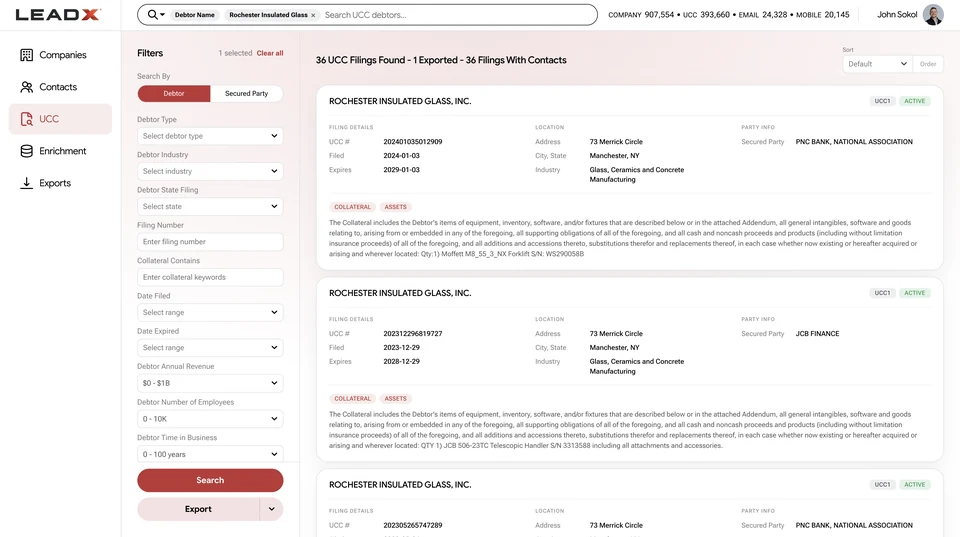
LeadX exposes the same resolved records through three delivery paths — synchronous REST calls for lookups, bulk files for backfills and refreshes, and an authenticated MCP endpoint so AI agents can query under your account's own permissions and credit limits. Entity resolution happens upstream, so you are not deduplicating vendors in your own pipeline.
Company, contact, email, mobile, UCC, BBB, and review endpoints with documented pagination and rate limits.
Enterprise bulk delivery for warehouse loads, internal scoring models, and data products.
An authenticated MCP server lets AI assistants call LeadX endpoints under your account's permissions.
Records arrive resolved to a single company, so joins do not become a deduplication project.
Embed company and contact lookups inside a SaaS product or internal application.
Land bulk company, contact, and filing data for analytics and scoring.
Append fields to records already flowing through an ETL or reverse-ETL job.
Give an internal assistant governed access to company and filing data over MCP.
It exposes company search, contact search, email and mobile lookup, UCC filing search, Better Business Bureau data, Google reviews, and a combined all-attributes endpoint. The base URL is https://api.leadx.com/v1. See API and bulk data.
Yes. Enterprise bulk delivery provides large targeted datasets as files, which is usually the right path for warehouse backfills, internal scoring models, and data products, with the REST API used for synchronous lookups.
Yes. LeadX publishes an authenticated MCP server, an A2A agent card, an agent capability catalog, and Web Bot Auth signatures. Agents call endpoints under your account's own permissions, rate limits, and credit charges rather than through a shared key.
API access uses credentials issued to your account. Authentication, pagination, rate limiting, and error handling are documented in the public getting-started guides.
Records are resolved to a single company entity upstream, so the same business does not arrive as several rows under name and address variants. That keeps joins in your own pipeline from turning into an entity-resolution project.
Search endpoints are paginated and rate limited, with both documented publicly in the pagination and rate-limiting guides, alongside retry and error-handling guidance for production integrations.