
See competing interests appear
Filings by other secured parties against businesses already in your book.
Track continuations, amendments, terminations, and new filings against the businesses you already finance — so additional leverage, a competing lender, or a renewal window shows up while you can still act on it.
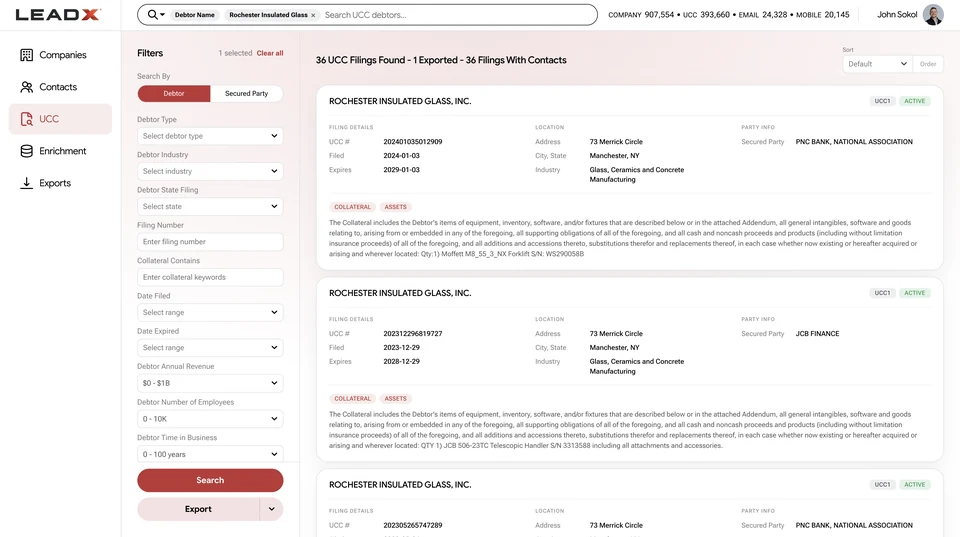
A portfolio changes quietly. A borrower takes on another facility, a competitor perfects an interest, a filing you rely on approaches lapse. Each of those is a public record, but only if someone is watching the right jurisdictions. LeadX monitors filing activity against a named set of companies and attaches the business context needed to judge whether it matters. Learn how to monitor UCC filing changes.
Filings by other secured parties against businesses already in your book.
Continuations, amendments, assignments, terminations, and approaching lapse dates.
Company, industry, reputation, and equipment context alongside the filing itself.
Scheduled reports on saved criteria, exports, or API access into internal monitoring.
Spot additional secured debt taken on by an existing borrower.
Track lapse and expiration dates to time a refinance conversation.
See which lenders are filing against your accounts.
Catch amendments that alter the collateral you rely on.
Monitoring is the part that has to keep running after the first search. LeadX turns a saved set of criteria into a scheduled report, and a named set of businesses into an ongoing watch list, so filing activity reaches you without anyone re-querying by hand.
Save a search and have new filings that match it delivered weekly or monthly, with recipients and record limits set per report.
Track an existing book, a target list, or an uploaded set of companies, and see filings recorded against them as they arrive.
Follow the whole filing lifecycle rather than the initial UCC-1, including approaching lapse dates on your own paper.
Watching public filing activity against a defined set of companies. That includes new filings by other secured parties, and changes to your own: continuations, amendments, assignments, terminations, and approaching lapse. See UCC filing data.
A new UCC-1 naming that business as debtor and a different secured party appears in the public record. Monitoring a named list of companies surfaces those filings as they are collected from each state.
Yes. A UCC-1 is generally effective for five years, and a continuation must normally be filed within the six months before expiry. Filing and lapse dates are searchable, so an approaching window can be reported before it closes.
It varies by state, because filing offices publish on different schedules and LeadX collects from each at its own cadence. The UCC filing data page covers this in more detail.
Yes. Saved search criteria can be turned into scheduled reports that run weekly or monthly and deliver the new filings that match, so monitoring continues without anyone re-running a search. The same queries are available through the API for teams that prefer to run monitoring inside their own systems. See UCC filing data.
A search answers what is on record today. Debtor tracking follows a named set of businesses over time and reports what changes: new filings by other secured parties, continuations and amendments on existing paper, and terminations. That difference is what turns filing data into an early signal rather than a snapshot.
Yes. Saved search criteria can drive scheduled reports, and the same queries are available through the API for teams running monitoring inside their own systems.
Not on its own. Perfecting a security interest is routine for equipment leases and asset-backed lending. What is informative is the pattern — how many filings, against what collateral, held by whom, and whether earlier ones remain active.