
Describe what converts
Firmographics, industry, geography, technology and web signals, reputation, and financing behaviour.
Start from the customers you want more of, extract what they have in common, and search the market for businesses that match on the attributes that actually predicted the deal.
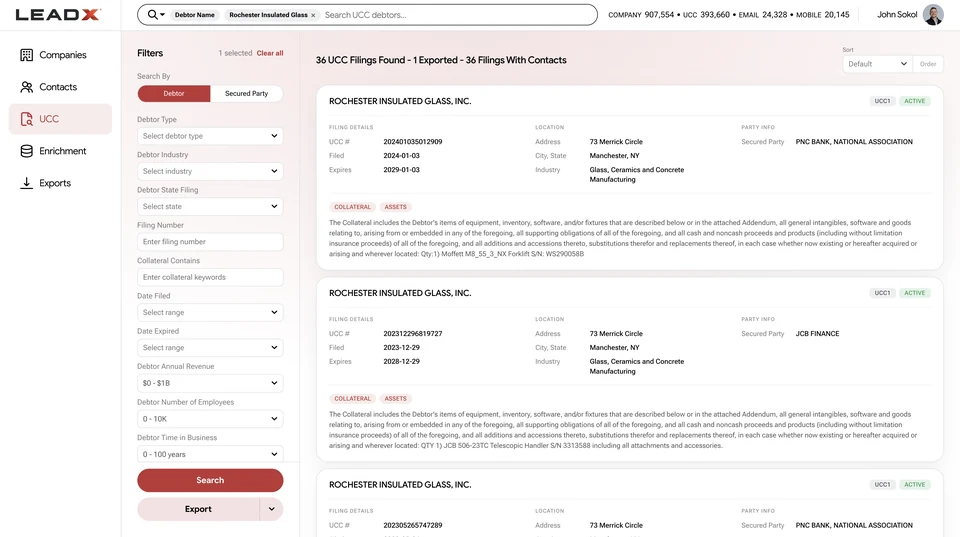
Written ICPs tend to describe an industry and a size band. Actual closed-won accounts often share something more specific: a class of equipment financed, a lender relationship, a web footprint, a regional pattern. LeadX lets a profile be built from those observable attributes rather than from a category, so expansion follows the evidence.
Firmographics, industry, geography, technology and web signals, reputation, and financing behaviour.
Combine attributes rather than filtering on one dimension at a time.
Sort candidates by how many profile attributes they share with the seed set.
Matches arrive with decision makers attached and can be pushed to CRM.
Grow a segment that already performs instead of testing a new one.
Carry a proven profile into a different geography or adjacent industry.
Find businesses matching a partner's or dealer's customer base.
Locate current accounts resembling your highest-value ones.
It is finding companies that resemble a chosen set of existing customers across observable attributes — industry, size, geography, web presence, technology, reputation, and financing behaviour — rather than filtering the market on a single category.
A filtered search applies criteria you specify. Lookalike discovery starts from accounts that already worked and searches on the combination of attributes they share, including ones you might not have thought to filter on.
Firmographics such as industry, NAICS and SIC, employee count and revenue range; location; website and technology signals; Google review and BBB reputation; and financing activity drawn from UCC filings and equipment ownership.
Enough that shared attributes are a pattern rather than a coincidence. A handful of accounts will surface obvious commonalities; a larger, more consistent set produces a profile that discriminates better between close and loose matches.
Yes, and in equipment-heavy markets it is often the sharpest signal. Fleet composition, manufacturer, and equipment category describe what a business actually operates, which frequently predicts fit better than industry code alone.
Yes. Results export directly or sync to HubSpot, Salesforce, Zoho, Pipedrive, and Microsoft Dynamics, and the same query is available through the API.