
Find businesses financing right now
Search filings by date, collateral, and status to isolate companies that financed in the last quarter, or whose paper is approaching lapse.
Every UCC-1 is a record of a business that just financed an asset. Search more than 50 million filings by collateral, lender, and geography to find companies in market now, see who financed them, and reach the decision maker before the next cycle.
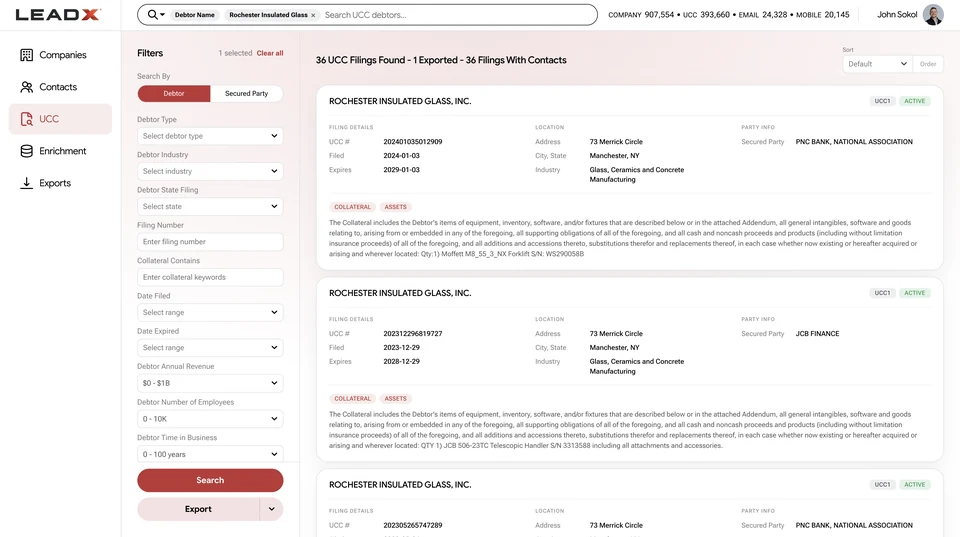
A filing tells you a business committed capital to an asset, which lender wrote the paper, and roughly when that deal comes up for renewal or replacement. LeadX joins that filing to the company behind it, the equipment in the fleet, and the people who sign, so a search produces a callable list rather than a research project.
Search filings by date, collateral, and status to isolate companies that financed in the last quarter, or whose paper is approaching lapse.
Secured-party search maps a competitor's book by debtor, geography, and collateral type, so you know whose paper you are displacing.
Connected equipment ownership data shows fleet size, category, and manufacturer, so you can size a deal before the first call.
Owners, CFOs, and controllers with verified email and mobile arrive with the filing, not in a separate enrichment step.
Build territory lists of businesses that financed equipment in your collateral classes.
Review equipment collateral, company details, and existing financing relationships to research fit with your lender network.
Watch your own book for continuations, amendments, terminations, and new filings by other lenders.
Review liens and business profiles before a funding conversation, and research equipment dealers as potential referral partners.
“Before I even reach out, I know what equipment they acquired on LeadX, when they acquired it [and] who financed it. I’m not cold calling the so-called tire kickers; I’m getting proven borrowers.”
“I got on the phone with them and got them approved right away.”
A UCC-1 records the moment a business financed an asset, so filings work as a timing signal. Equipment finance teams use them three ways: to find companies that just bought and will buy again, to see which lender holds existing paper, and to monitor a portfolio for amendments, continuations, and competing filings. See UCC filing data.
Search filings by filing date and collateral, then narrow by geography, industry, and company size. Because LeadX connects each filing to a full company record, the result is a list of qualified businesses with contacts attached rather than debtor names you still have to research.
Yes. Every filing names the secured party. You can look up a single company's lenders, or run the search in reverse — secured-party search returns every debtor tied to a given lender, which is how teams map a competitor's book of business by territory and collateral type.
A general list tells you a company exists and roughly what it does. Filing data tells you it committed capital to a specific asset on a specific date and who financed it. For equipment finance that difference is the whole qualification step, because it separates a company that might buy from one that demonstrably does.
Yes. Equipment ownership data resolves machines to the business that owns them, with fleet size, composition, manufacturer, and ownership changes over time. Paired with filings it shows both what a business runs and how it paid for it.
Yes. Beyond free-text collateral matching, filings carry a structured asset classification, so searches can target categorised equipment rather than relying on how a filing clerk phrased the collateral description. That is what makes it practical to isolate a specific collateral class across a territory.