
Find businesses with borrowing history
Companies with existing filings have shown they finance. Search by filing recency, collateral, and lender to find them.
Help relationship managers find businesses in their market, prepare for borrower conversations, and review financing activity across commercial accounts.
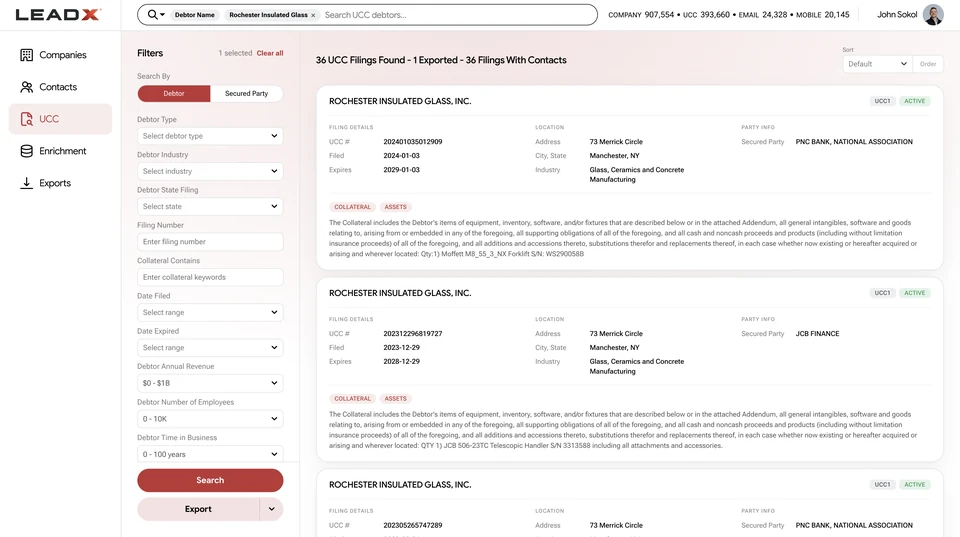
Banks need a clear picture of the businesses they serve. LeadX connects company records, UCC filings, operating signals, and contacts so commercial teams can research prospects, prepare for credit review, and track filing activity across existing relationships.
Companies with existing filings have shown they finance. Search by filing recency, collateral, and lender to find them.
Review filing status, collateral scope, and secured parties to understand where a new facility would sit.
Firmographics, web presence, Google reviews, and BBB signals corroborate that a borrower is real and active.
Owner, CFO, and controller records with verified email and mobile arrive with the company.
Build lists of businesses with demonstrated financing behavior in your target markets.
Pull filings, collateral, reputation, and firmographics before an application is worked.
Track new filings against existing borrowers as an early signal of additional leverage.
Research company profiles and financing history before discussing additional banking needs with business owners.
Typically four layers: firmographics to confirm the business is real and sized correctly, public filings to see existing secured debt, reputation signals such as Google reviews and BBB records to sanity-check operations, and contact data to reach the signer. LeadX provides all four against the same resolved company record.
Search UCC filings by date, collateral, and geography. A business with recent filings has demonstrated it finances assets and works with lenders, which is a stronger signal than firmographics alone.
Yes. A debtor search returns the filings against a business, with secured party, collateral description, filing dates, amendment history, and current status — so you can see whether a lien is active, lapsed, or terminated before extending credit.
Yes. Filing activity against a company you have already lent to can indicate additional leverage or a competing lender. Filings can be tracked in the platform or pulled through the API into your own monitoring workflow.
No, and it is not meant to be. Filing data establishes who holds security interests and when they were perfected. It is a research and prioritization input that sits alongside financials, bank data, and your own credit policy — not a substitute for them.
Yes. Filings can be filtered by collateral description and by structured asset classification, so you can restrict a search to the asset classes you actually lend against and exclude the ones you do not.